Evaluating Seamless 3D Christmas Flowers Pattern for Professional Holiday Design Projects
The holiday season places unique demands on graphic designers, crafters, and digital content creators. Whether you are preparing sublimation prints for a small business, designing wedding invitations with a winter theme, or updating blog backgrounds for December traffic, the quality of your assets directly impacts the perceived value of your final product. Among the myriad of options available, the Seamless 3D Christmas Flowers Pattern has emerged as a distinct category of digital paper that bridges the gap between traditional flat illustrations and high-end photographic textures.
Understanding what sets this specific style apart from standard clipart or vector graphics is essential for making an informed decision about your design resources. This analysis explores the technical specifications, practical applications, and comparative advantages of using high-resolution, seamless 3D floral patterns in your festive projects.
Defining the Aesthetic: What Makes 3D Floral Patterns Distinct?
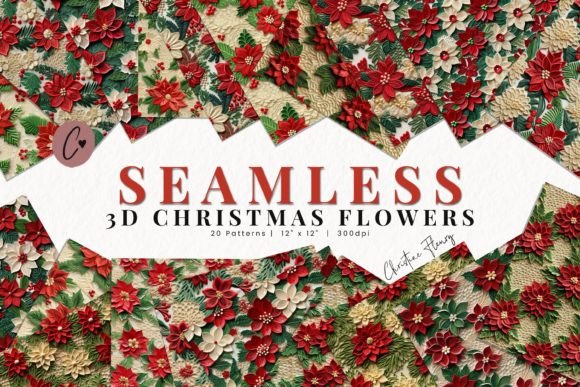
When we refer to a Seamless 3D Christmas Flowers Pattern, we are describing a digital asset that utilizes depth, shading, and lighting effects to create the illusion of physical objects resting on a surface. Unlike flat, two-dimensional vectors which rely on solid colors and clean lines, 3D patterns simulate texture. You might see the velvet softness of a poinsettia petal, the glossy sheen of a holly berry, or the intricate layering of pine needles.
The "seamless" aspect is technically critical. A seamless pattern tiles infinitely without visible edges or breaks. This allows designers to cover large areas—such as wrapping paper, fabric rolls for sublimation, or full-page website backgrounds—without the distraction of repeating grid lines. When combined with the 3D aesthetic, the result is a rich, immersive visual experience that feels tactile and premium.
For professionals evaluating resources, it is important to distinguish these from simple photographs. While a photograph captures a real scene, a designed 3D pattern offers controlled composition. The elements are arranged to ensure balance and repeatability, providing a consistency that random photography often lacks. This makes them particularly suitable for structured design tasks like card making and invitation layouts where symmetry and predictability are valued.
Technical Specifications and Quality Standards
The utility of any digital paper is largely determined by its resolution and file format. In the context of the Seamless 3D Christmas Flowers Digital Paper pack described here, the technical specs are tailored for both print and high-quality digital display. The inclusion of 20 individual digital papers provides a diverse palette, allowing for cohesive yet varied design systems.
- Resolution: At 3600 x 3600 pixels, these images offer substantial detail. This high pixel count ensures that when scaled down for web use, the image remains crisp, and when printed at standard sizes, the edges remain sharp.
- DPI (Dots Per Inch): Designed at 300 DPI, these files meet the industry standard for professional printing. This is a crucial differentiator. Many free or low-cost online resources provide images at 72 DPI, which are suitable only for screens. Using a 72 DPI image for a printed invitation or sublimation transfer will result in pixelation and blurriness. The 300 DPI specification ensures that the 3D textures retain their depth and clarity on physical media.
- Format: The .JPG format is universally compatible. While PNGs support transparency, JPGs are generally smaller in file size and are the standard for background patterns where a solid or textured base is required. This compatibility simplifies the workflow for users across different software platforms, from Adobe Photoshop to Canva or Cricut Design Space.
- Dimensions: The 12 x 12 inch square format is the standard for scrapbooking and many craft printers. It allows for easy integration into pre-made templates without significant cropping or resizing.
Comparative Analysis: 3D Patterns vs. Traditional Alternatives
When choosing assets for Christmas projects, designers typically weigh three main categories: flat vector illustrations, photographic backgrounds, and 3D rendered patterns. Each has its place, but the Christmas Patterns featuring 3D flowers occupy a unique middle ground.
Flat Vectors vs. 3D Renders
Flat vectors are excellent for minimalist, modern designs. They are scalable to any size without loss of quality and are easy to recolor. However, they can sometimes feel cold or impersonal for holiday themes, which often rely on warmth and tradition. The Seamless 3D Christmas Flowers Pattern adds emotional weight through texture and lighting. If your goal is to evoke nostalgia, luxury, or coziness, the 3D approach is often more effective than flat geometry.
Photography vs. Designed Patterns
Stock photography offers realism but lacks control. A photo of a Christmas arrangement may have awkward negative space, inconsistent lighting, or elements that distract from your text overlay. Designed digital papers allow you to place text or foreground elements with confidence, knowing the background is balanced. Furthermore, seamless tiling is impossible with standard photography without complex editing. For backgrounds in web design or large-format printing, the seamless nature of these digital papers offers a logistical advantage that photos cannot match.
Practical Applications and Best-Fit Scenarios
Understanding where these assets shine helps in determining if they are the right choice for your current project. Here are several scenarios where Printable Festive Paper with 3D floral motifs excels:
- Sublimation Printing: Sublimation requires high-resolution images to transfer cleanly onto fabrics, mugs, and ornaments. The 300 DPI resolution and vibrant color depth of 3D renders ensure that the final product looks professional rather than washed out. The seamless nature allows for all-over prints on tumblers or pillows without visible seams.
- Scrapbooking and Card Making: For physical crafts, the 12 x 12 format is ideal. The 3D effect adds a layer of sophistication to handmade cards, making them appear more expensive and detailed. When used as a background for photos in scrapbooks, the texture provides context without overpowering the main subject.
- Digital Invitations and Stationery: Holiday parties and corporate events often require digital invites. The rich textures of 3D flowers convey elegance. Since these are JPGs, they are easy to embed in emails or upload to invitation platforms without compatibility issues.
- Web and Blog Design: Seasonal website updates benefit from backgrounds that are visually interesting but not distracting. A subtle, tiled 3D pattern can add festive cheer to a header or sidebar without slowing down page load times significantly, provided the files are optimized.
Limitations and Decision Factors
While versatile, this type of asset is not a universal solution. It is important to recognize when a different approach might be necessary.
Text Legibility: The primary challenge with highly detailed 3D patterns is text contrast. Because the images contain shadows, highlights, and complex shapes, placing text directly over them can reduce readability. Designers should consider using semi-transparent overlays, solid text boxes, or choosing patterns with more negative space if heavy typography is required.
Style Consistency: The 3D aesthetic is specific. If your brand identity is strictly minimalist, flat, or hand-drawn sketch style, a realistic 3D flower pattern may clash. These assets work best with designs that embrace richness, tradition, or a touch of glamour. They may feel out of place in ultra-modern, starkly geometric layouts.
File Editing: As JPG files, these images do not have transparent backgrounds. You cannot easily isolate individual flowers to move them around. You are buying the pattern as a complete composition. If you need to manipulate individual elements, you would need to source vector files or layered PSDs instead. For most background and paper uses, this is not an issue, but it is a constraint for composite editing.
Making the Right Choice for Your Project
Selecting the right digital resources involves balancing aesthetic goals with technical requirements. The Seamless 3D Christmas Flowers Pattern offers a compelling option for creators who need high-impact, festive visuals that perform well in both print and digital formats. Its strengths lie in its resolution, seamless tiling capability, and the emotional resonance of its 3D texture.
If your project demands a premium, tactile feel—such as high-end gift wrap, sophisticated holiday invitations, or professional sublimation products—this type of digital paper is a strong candidate. However, if you require extensive customization of individual elements, transparent backgrounds, or a minimalist aesthetic, you may need to explore vector libraries or flat design alternatives.
By understanding the tradeoffs between resolution, format, and style, you can integrate these assets effectively into your workflow. The key is to match the richness of the 3D pattern with appropriate layout choices, ensuring that the background enhances rather than competes with your primary content. With 20 varied designs in a high-resolution format, such a collection provides the flexibility needed to maintain visual interest across multiple projects while ensuring a cohesive holiday theme.